
VIEW FULL COURSE %100 FREE
1. The Cockroach-Infested Reality of Worry
Before he was the architect of modern interpersonal strategy, Dale Carnegie was a man drowning in New York City’s version of a low-bandwidth nightmare. In 1912, Carnegie lived in a cheap, furnished room on West Fifty-Sixth Street that smelled of disappointment and stale grease. He shared the space with an army of cockroaches that would explode in a frantic scatter the moment he reached for a necktie in the morning. He spent his days selling motor trucks a job he loathed and didn't even understand and his nights eating "vile food" in dirty restaurants.
The result? A recurring, high-tension sick headache bred by bitterness and rebellion. This was Carnegie’s "Rubicon" moment. He realized he had everything to gain and nothing to lose by giving up the work he loathed. He chose to pivot, deciding to teach public speaking in Y.M.C.A. night schools not out of academic theory, but to wipe out his own timidity and lack of confidence. His strategies weren't born in an ivory tower; they were forged in a laboratory of practical desperation where results were the only currency.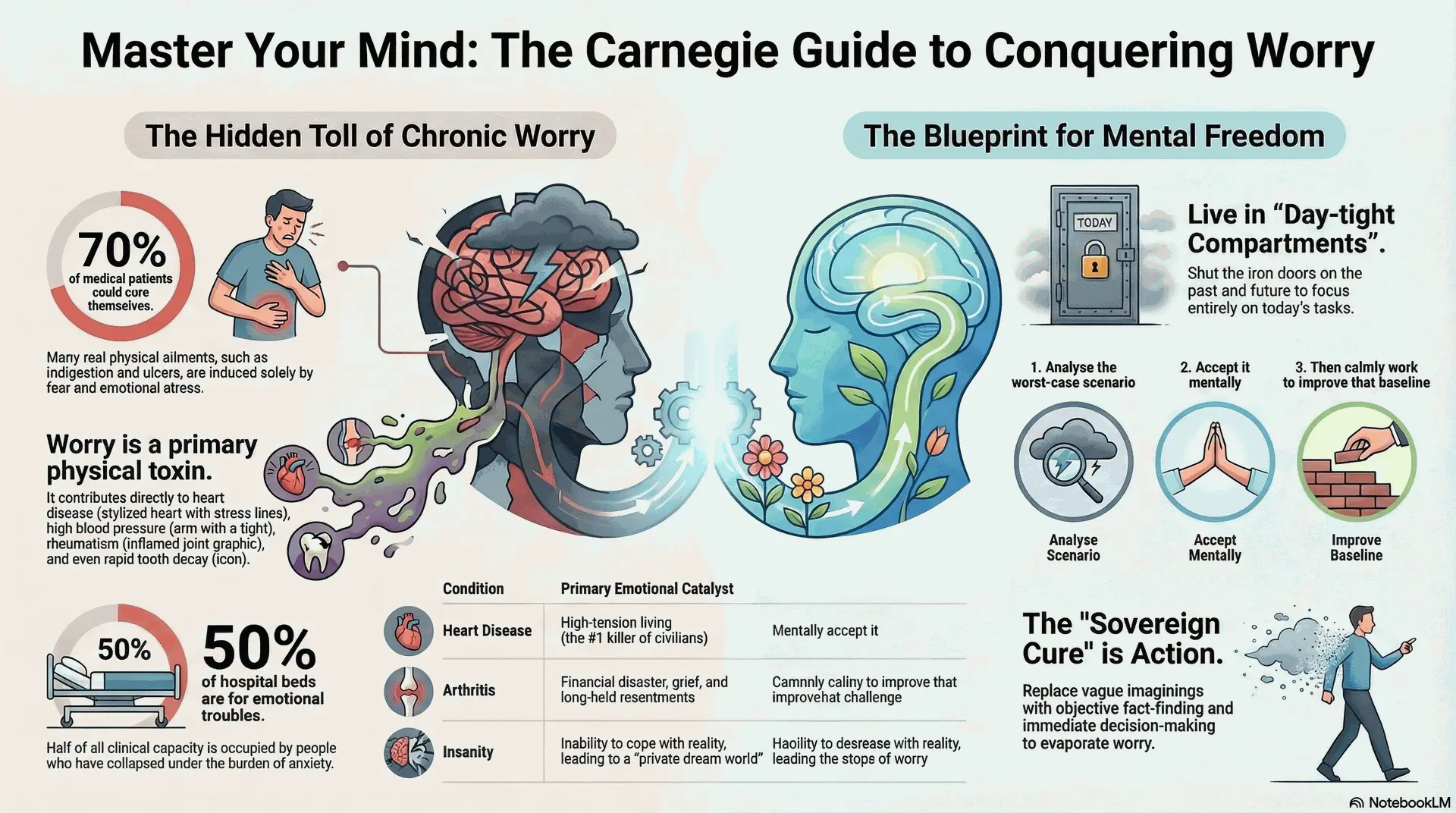
2. The "Day-Tight Compartments" Strategy
One of the most effective tools for managing your cognitive load is a concept coined by Sir William Osler: "Day-tight Compartments." Osler, the legendary physician who organized the Johns Hopkins School of Medicine, argued that even a "mediocre" mind can achieve high performance by shutting out the past and future.
Osler used the analogy of a great ocean liner. A captain on the bridge can press a button and presto! iron doors clang shut, sealing the ship into watertight compartments to ensure safety. To survive the modern age of 24/7 news cycles and digital noise, you must do the same. This isn't just a platitude; it’s a biological survival mechanism. By "shutting the iron doors" on dead yesterdays and unborn tomorrows, you protect your mental bandwidth from the crushing weight of accumulated anxiety.
"Our main business is not to see what lies dimly at a distance, but to do what lies clearly at hand." Thomas Carlyle
3. The Willis H. Carrier Magic Formula
When a high-stakes problem threatens to paralyze your decision-making, apply the strategy developed by Willis H. Carrier. As the "blue-chip" founder of the air-conditioning industry, Carrier used a three-step "magic formula" to navigate technical failures and financial ruin.
The Three-Step Protocol:
- Analyze the "Worst-Case Scenario" Fearlessly: Deconstruct the situation. Carrier once faced the failure of a $20,000 gas-cleaning device. He asked: What’s the floor? In his case, it was the loss of the investment and his reputation not jail or death.
- Mentally Reconcile with the Worst: Accept it. A New York oil dealer once used this to handle a $5,000 blackmail attempt. Once he accepted that his business might be ruined by the publicity, his "blue funk" lifted. Acceptance is the first step in overcoming the consequences of misfortune.
- Calmly Improve Upon the Accepted "Worst": With your mind "rebooted" by acceptance, devote your energy to salvage. Carrier spent $5,000 on new equipment and turned a potential $20,000 loss into a $15,000 profit.
4. Worry is a Biological Debt (And the Interest is Killing You)
Worry isn't just a mental state; it’s a physical toxin that creates a massive biological debt. As Nobel Prize winner Dr. Alexis Carrel warned:
"Business men who do not know how to fight worry die young."
The medical data from the Mayo Clinic and beyond is staggering:
- The 50% Rule: More than half of all hospital beds are occupied by people with nervous and emotional troubles bodies that collapsed under the weight of "yesterday" and "tomorrow."
- The 1-in-20 Stat: One American in every twenty will spend part of their life in a mental institution.
- The Ulcer Insight: Dr. Joseph F. Montague famously noted that you don't get ulcers from what you eat; you get them from "what is eating you."
- The Executive Toll: A study of 176 executives (average age 44) showed that one-third suffered from heart disease, ulcers, or high blood pressure before they even hit middle age.
In our digital age, these "cortisol spikes" are even more lethal. High blood pressure and heart disease are the physical interest you pay on a debt of worry.
5. The "New Life" Mindset: Environmental Cues for the Wise
To prevent mental collapse, you must shift from a "lifetime" view to a "bedtime" view. Mrs. E. K. Shields, a book salesperson driven to the brink of suicide by financial fear, found her turning point in a single sentence: "Every day is a new life to a wise man."
She used a modern "environmental trigger" typing that sentence and pasting it on the windshield of her car to stay grounded. This shift allows you to live in the "tissue of every day and hour." As Robert Louis Stevenson observed, anyone can carry their burden or live "sweetly, patiently, lovingly" until the sun goes down. That is all life actually requires.
6. Rock Bottom as a Launchpad: The Earl P. Haney Case
If you want the ultimate masterclass in "cooperating with the inevitable," look at Earl P. Haney. Diagnosed with incurable duodenal ulcers, Haney decided to go out with swagger. He bought a casket, put it in a ship’s freezing compartment, and embarked on a "f*** it" tour of the world.
While waiting to die, he drank highballs, smoked long cigars, and ate "strange native foods" that were guaranteed to kill him. He leaned into the adventure of monsoons and typhoons. By accepting the "worst" (death) and focusing on "making the most of what we yet may spend," he released the tension destroying his body. He gained ninety pounds, sold the casket back to the undertaker, and returned to business completely cured.
7. Conclusion: The Meeting-Place of Two Eternities
We stand at the meeting-place of two eternities: the vast past and the future that is "plunging on to the last syllable of recorded time." We cannot live in either. The core problem for most is not an ignorance of these truths, but inaction. We don't need to be told anything new; we need to be kicked in the shins until we apply what we already know.
Think of your life as an hourglass. Thousands of grains of sand sit in the top, but they can only pass through the narrow neck one at a time. If you try to force more through, you break the structure.
The question for the high-performance reader is simple: Which single grain of sand are you going to focus on right now?
VIEW FULL COURSE %100 FREE